
Radboud Langenhorst
4 minutes
Business AI isn’t plug-and-play. At least, not if you want to do it right.
Most investors won’t necessarily love hearing this, but it is reality.
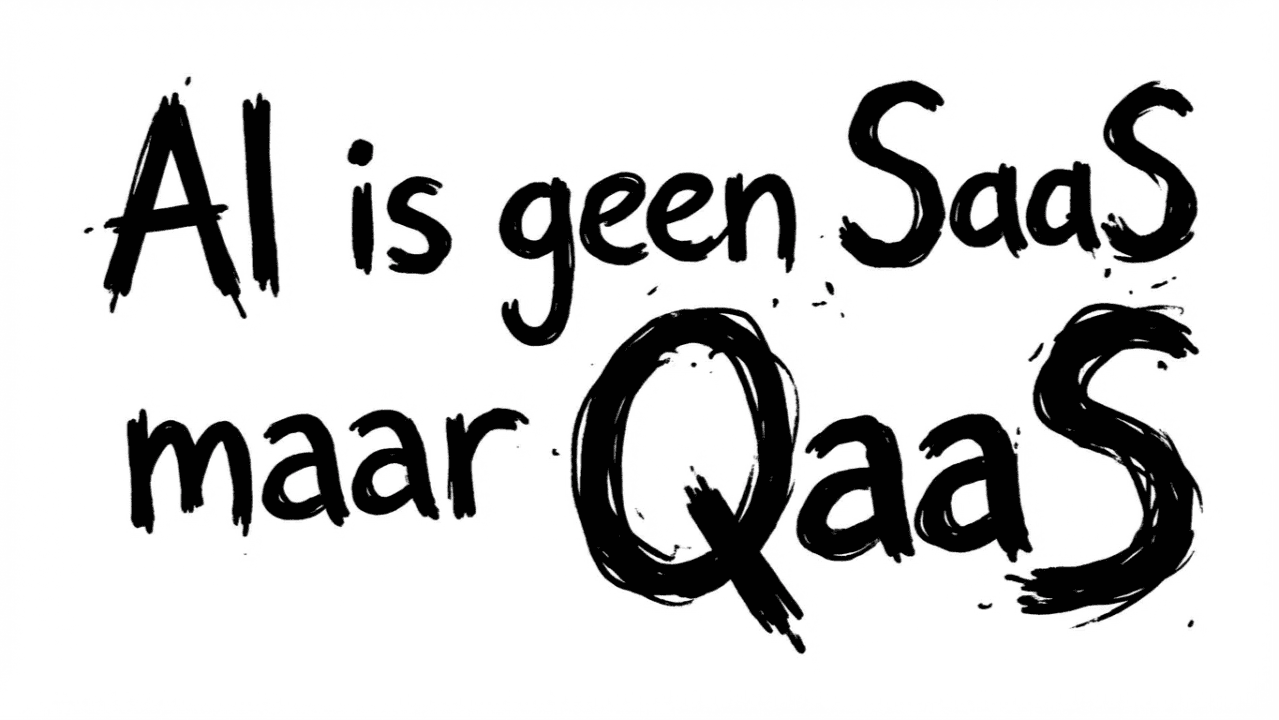
Call it Quality as a Service. It makes my job incredibly interesting, but also challenging. Because AI is perceived as “easy” due to personal use, you quickly run into friction when real business impact lags behind.
So then what? Is it just hype? Did you work with the wrong partner? Or should AI go back to the bottom of the priority list?
First, a few key observations from me and AI Opener, after more than two years in the trenches of AI:
The technology is here. And it’s more than good enough to:
significantly improve efficiency across organizations and departments and reduce costs
deliver better output (commercial, operational, administrative) than before
lay the groundwork for fundamentally rethinking marketing, sales, customer service, finance, and more
force critical thinking about what your proposition looks like 24 months from now
So the question is not whether AI can do this.
The question is: how your organization does this well.
1. The foundation
Not tooling, but conditions
For us, the foundation isn’t “a model” or “an agent.” It’s about creating the right conditions to deploy AI responsibly.
At AI Opener, that means:
A platform where organizations can securely and compliantly share context and data
Agents for marketing, sales, operations, etc. that are not generic, but infused with domain and company knowledge (the real secret sauce)
A pragmatic model strategy:
cheap where possible, premium where it matters
2. Going for impact
Where AI actually succeeds (and where it often fails)
This is the part most organizations underestimate.
Implementing AI is not about automating work.
It’s about rewriting how work gets done.
And that affects three things at once:
a. Teams: who does what, and who owns what?
As agents start contributing, roles and responsibilities shift.
Questions you need to answer explicitly:
Who initiates the work?
Who validates the output?
When can an agent act autonomously?
When does a human step in?
Who owns the final outcome?
Where are decisions made and by whom?
AI can take over tasks. But not responsibility.
So who are the “directors” in your process?
This means you need to map your current way of working.
Not plug-and-play.
More like prep-and-play.
b. Tools: we’re already overloaded—and now there’s another one
Most teams already operate with a stack of tools: Slack, Notion, Asana, Monday, HubSpot, Salesforce, Teams, Google Workspace, Microsoft 365… the list goes on.
So:
How do agents fit into your existing stack and workflows?
Should you redesign those workflows anyway?
Who decides? Business, IT, or both?
Documenting this properly, and having the courage to rethink it, is critical.
It may sound like extra work, but in practice it’s often liberating.
And accept this:
Where tools used to support your work,
AI can start doing parts of that work.
From AI tools → to AI teams.
c. What is success and how do we measure it?
Probably the most underestimated question.
AI initiatives don’t fail because they deliver nothing.
They fail because no one defines what success actually means.
Are you aiming for:
time savings?
higher output?
better quality?
fewer errors?
faster decision-making?
And just as important: when do you decide it works?
AI is not a 4-week campaign.
It’s not a new hire that’s fully productive on day one.
It’s new, evolving fast, and garbage in = garbage out.
If you don’t define success clearly and accept a realistic learning curve,
you’re setting yourself up for disappointment.
And that disappointment is too easily blamed on AI—or the vendor.
3. The human trap: the “I told you so” reflex
What I see most in practice: AI gets no onboarding time.
One bad output and the verdict is immediate:
“See? It doesn’t work.”
Meanwhile, we give new hires months to:
learn the craft
understand the organization
make mistakes
We’re more forgiving to interns than to agents.
And if there was skepticism upfront, every mistake becomes confirmation. Not a learning moment but a conclusion.
That’s the real risk.
Not the technology.
But our instinctive response to change.
You can tie this back to the “reptile brain”, wired for survival, reacting instinctively to uncertainty. Every major unknown change feels like a threat. Fight. Flight. Freeze.
I speak with prospects and clients every week and still see all three:
avoiding AI tools altogether (flight)
resistance during implementation (fight)
complete uncertainty about what to do next (freeze)
That’s not a technology problem.
That’s a leadership. And yes, AI is abstract, complex, and unpredictable.
But that’s on you.
Make AI concrete. Make responsibilities explicit. Make success measurable. Make your way of working visible.
Don’t treat AI like a tool. Treat it like a colleague.
AI is not an IT project. Not a marketing experiment. Not an innovation bullet point on a slide.
It’s an organizational question.
Those who treat AI as tooling stay stuck in pilots.
Those who treat AI as a redesign of work build a real advantage.
At AI Opener, together with our technology partner Artific, we build commercial agents that accelerate, improve, and enhance work. And we support organizations that understand that real AI impact starts with how you work.
PS: Still in fight, flight, or freeze mode?
Read this incredibly sharp piece by Matt Shumer but be warned, he doesn’t hold back: https://www.linkedin.com/pulse/something-big-happening-matt-shumer-so5he/