

Radboud Langenhorst
3 minutes
Stop chasing the latest AI tools. Build a foundation first.
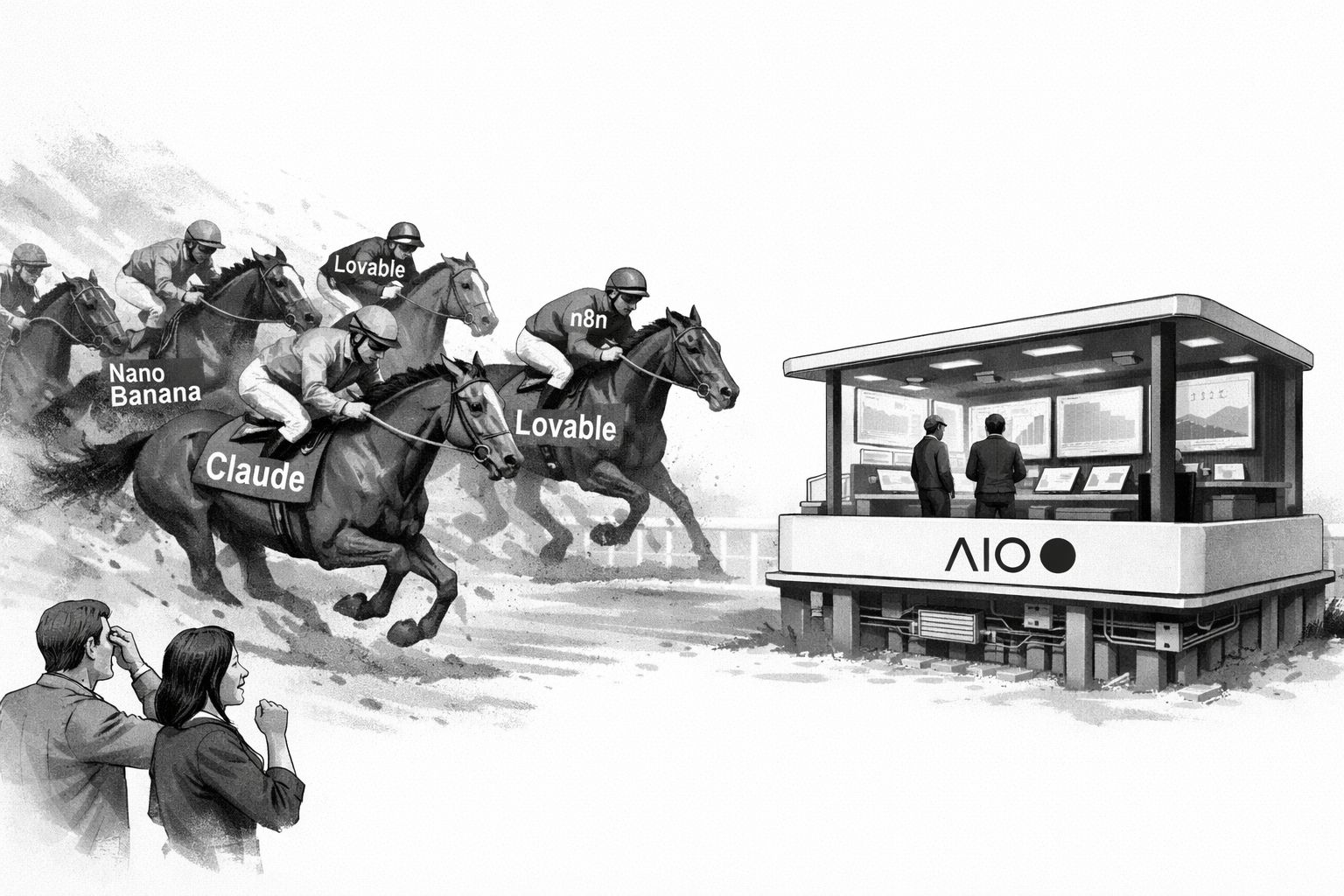
Every few months a new AI tool appears that everyone suddenly needs. Claude Cowork. Nano Banana. Lovable. n8n. The names change, the hype doesn't. And in the meantime, organisations are making structural decisions based on whatever happens to be trending at the coffee machine this week.
That pattern is not harmless.
The AI puzzle isn't solved yet
In mid-2026, nobody has figured out the definitive AI stack. Not Microsoft. Not Google. Not the startup that raised a $200M Series B last month. Models improve every quarter, and the tools built on top of them appear and disappear just as fast. What's cutting-edge in January is table stakes by April and quietly deprecated by October.
This is what a market looks like when it's still forming. Organisations that understand this stop trying to pick the winning tool and focus on something more fundamental: building in a way that doesn't require starting over every time the landscape shifts again.
The risk nobody's talking about loudly enough
The latest generation of agentic tools, including Claude Cowork, give AI models direct access to laptops, files, inboxes, and employee devices. The capabilities are impressive. So are the risks, especially for organisations that haven't established proper AI governance yet.
And most organisations haven't. The majority of enterprise AI usage in 2026 still runs through personal accounts, outside any governance framework, data policy, or EU AI Act compliance structure.
When you give an AI model access to your systems without a governed layer in between, you're accepting three concrete risks. First, data exposure: sensitive company information, client data, and internal documents entering systems without any oversight. Second, compliance risk: the EU AI Act is live, the fines are real, and uncontrolled AI usage creates direct liability. Third, shadow AI: employees adopting tools individually, building workflows that IT doesn't know about, creating dependencies that nobody manages.
Regulators are catching up fast. The question isn't whether this becomes a problem, but when it becomes visible at your organisation.

Two strategies, one winner
You can keep betting on whichever horse looks fastest this month. Adopt the new tool, rebuild your workflows, train your team, and repeat the whole cycle ninety days later when something shinier comes along. Many organisations do this, consciously or not.
The other option is building a foundation that lets you run any horse, without starting over each time. Less exciting to talk about. Fewer clicks on LinkedIn. But the only approach that actually scales.
What a foundation looks like in practice
The answer is middleware: a governed layer between your organisation and the AI models you use. Not glamorous, but absolutely critical. In that layer you establish governance, making clear who can use what, for which purposes, and within which boundaries. You protect data, keeping sensitive information inside your own infrastructure. You maintain audit trails of what your AI is doing, when, and why — which under the EU AI Act is no longer optional. And you keep the freedom to switch models when it makes sense, without having to rebuild your entire technical foundation to do so.
Model-agnostic isn't a philosophical preference. It's a structural decision that protects your organisation from being held hostage by a single vendor, pricing structure, or the next AI trend.
Security as a foundation, not an afterthought
Together with our partner Artific, we built the AIO One platform: hosted in the Netherlands, built to GDPR standards, designed for organisations that take AI seriously. Recently, we commissioned an independent penetration test for our client Basic Fit. The test attempted to access user data, extract prompts, and push the AI outside its intended behaviour.
We passed. And that gives us the confidence to keep moving. To test new models, adopt new capabilities, and let our clients do the same without exposing themselves in the process.
The foundation holds. Everything built on top of it can keep evolving.
The bottom line
AI changes every month. The tools dominating the conversation today will be footnotes by next year. The organisations that navigate this best aren't the ones who adopted every new tool fastest. They're the ones who built the infrastructure early enough to absorb change without chaos.
Stop betting on the shiniest horse. Bet on the track.
Curious how a model-agnostic, GDPR-compliant AI platform could work for your organisation? Reach out to us.
Read more 👉